AI with numbers you can defend

Stop guessing what AI does for you. Measure it.

BLYNT Labs measures how a process performs today, tests improvements against the same test suite and reports an impact that Engineering can defend and Finance can review.

The problem

AI is already in your company. The numbers aren't.

Pilots get launched, licenses get bought and savings get announced. But when someone asks "how much did we gain, and how do you know?", almost nobody has an answer that survives a review.

Pilots that can't be compared

Every test uses different data, criteria and models. Nobody knows whether the new version is better or just different.

Savings nobody can defend

Measured hours get mixed with hoped-for hours. Finance won't sign off on what it can't trace back to the source data.

Risk without control

Without governance, trained people and evidence, the AI that works today is the AI that fails tomorrow's audit.

What the data says

Everyone is investing in AI. Few can prove it pays off.

Surveys published in 2026 by the world's largest consulting and research firms point to the same gap: adoption is high, but scale, governance and measurable returns are not.

22%

of organizations have scaled AI across multiple business units. 11% of leaders don't even know what their function spent on AI in 2025.

47%

of companies have skipped their own AI governance process to launch something urgent, while 91% already use agentic AI.

25%

of the workforce uses AI regularly, according to CEOs. Yet 86% of CEOs believe their employees have the skills to work with AI.

56%

of CEOs see no significant financial benefit from AI to date. Only 12% have achieved both lower costs and higher revenue.

See all 2026 surveys (most recent first)
SourceSampleAdoptionMaturity and results
EY · Autonomous AI governanceSep 15, 2026202 senior AI decision-makers, US listed companies with $1B+ revenue91% already use agentic AI49% haven't updated their governance framework. 47% skipped their own governance process for urgent deployments. 36% had an AI incident with a materially negative impact. 26% can't detect unauthorized agents.
GartnerSep 1, 20261,303 organizations with $50M+ revenue, Jan–Apr 202685% of functional leaders plan to increase AI spending in 2026Only 22% have scaled AI across multiple business units. 11% don't know what their function spent on AI in 2025.
McKinsey · The state of AIAug 25, 20261,719 respondents, 97 countries, May–Jun 2026Nearly 9 in 10 use AI regularlyOnly 44% say AI is scaling across their enterprise. 37% see some EBIT impact. High performers remain 6%.
Endeavor · Colombia AI PulseAug 25, 2026 · Colombia493 Colombian companies, Jul 202661% consider AI a strategic priorityOnly 0.2% reach advanced maturity. 93.5% remain in exploration and development.
EY · AI PulseJul 28, 2026534 US SVP+ leaders, Apr–May 202687% have deployed or are piloting in-house, AI-built software72% are hitting a wall where cost, talent and trust intersect. Among companies using token-based tools, 98% are reconsidering their approach as token costs rise. 64% monitor token usage with clear budget guardrails.
KPMG · Q2 AI PulseJun 24, 2026204 US leaders, companies with $1B+ revenue53% are deploying agents (55% the previous quarter)18% orchestrate multiple agents across workflows (up from 9%). Only 26% have real-time visibility into what their AI costs. Employee resistance rose from 5% to 20%.
IBM · CEO StudyMay 4, 20262,000 CEOs, 33 geographies86% of CEOs believe employees have the skills to work with AICEOs say only 25% of the workforce uses AI regularly.
BCG · AI RadarJan 15, 20262,360 executives, including 640 CEOsCompanies plan to double AI spending in 202694% of CEOs will keep investing even if it doesn't pay off within the next year.
PwC · Global CEO SurveyJan 19, 2026*4,454 CEOs, 95 countries56% see no significant financial benefit to date. Only 12% achieved both cost and revenue benefits.
Deloitte · State of AI in the EnterpriseJan 21, 2026* · full report3,235 leaders, 24 countries66% report productivity gainsOnly 20% are already growing revenue through AI. Only 21% have a mature model for agent governance.

* Published in 2026; fieldwork carried out in late 2025. Figures quoted as stated in each original source.

The challenge is no longer adopting AI. It's proving what works and turning it into a capability.

How we work

A six-step cycle, from the real process to a signed-off impact

Every use case follows the same path. Nothing is taken as good without a comparable test and the sign-off of someone from your company.

Define

The problem, the goal, the volume and the time your team spends on it today.

Baseline

We freeze how the process performs today. Your company signs it off as the starting point.

Analyze

Deterministic rules, with no AI, find where quality, time or money is lost.

Improve

We propose concrete changes and test them against the same test suite.

Validate

It only passes if it meets the guardrails agreed before testing. Your company signs off.

Impact

Hours that can be freed and AI spend avoided, with every assumption visible and traceable.

See the full cycle in the framework →

See it in action

A BLYNT use case, from start to finish

Four and a half minutes: how a case is defined, measured, improved and proven. A fictional example with synthetic data.

The product

BLYNT Platform: the framework, at work

BLYNT Platform is the software blynt labs builds and uses to run every case. Access is included in every assessment and program: your company signs in to review the results, sign off decisions and download reports. It doesn't connect to your systems or call AI models.

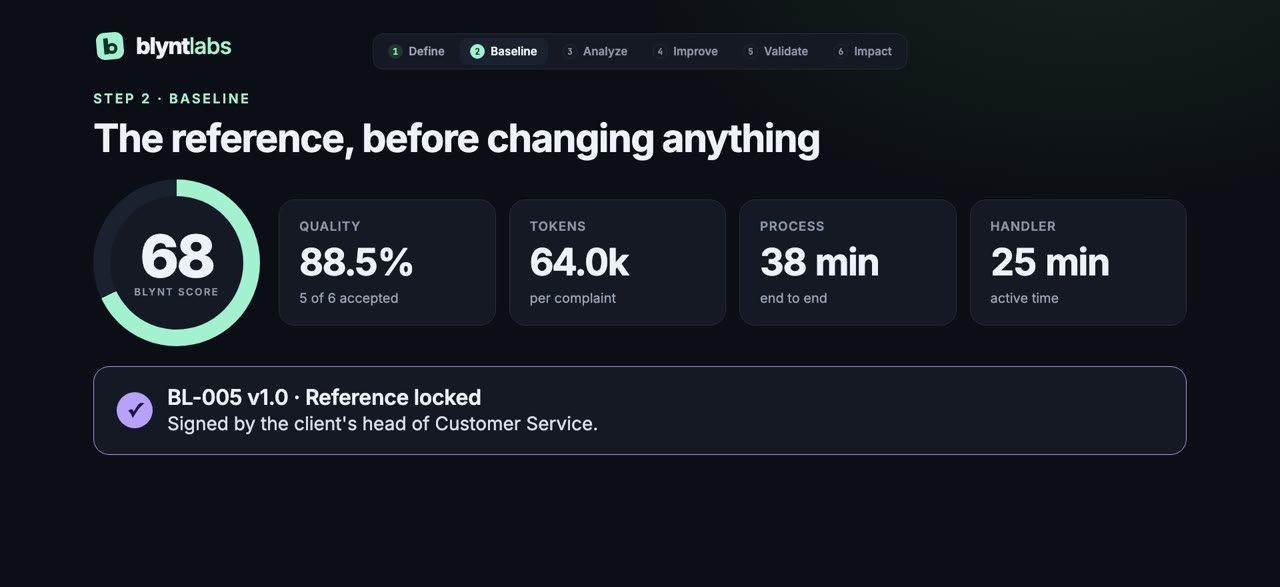
BLYNT Platform screen: Baseline
The full test suite runs on the current process. BLYNT calculates the Score and your company signs it off as the reference.
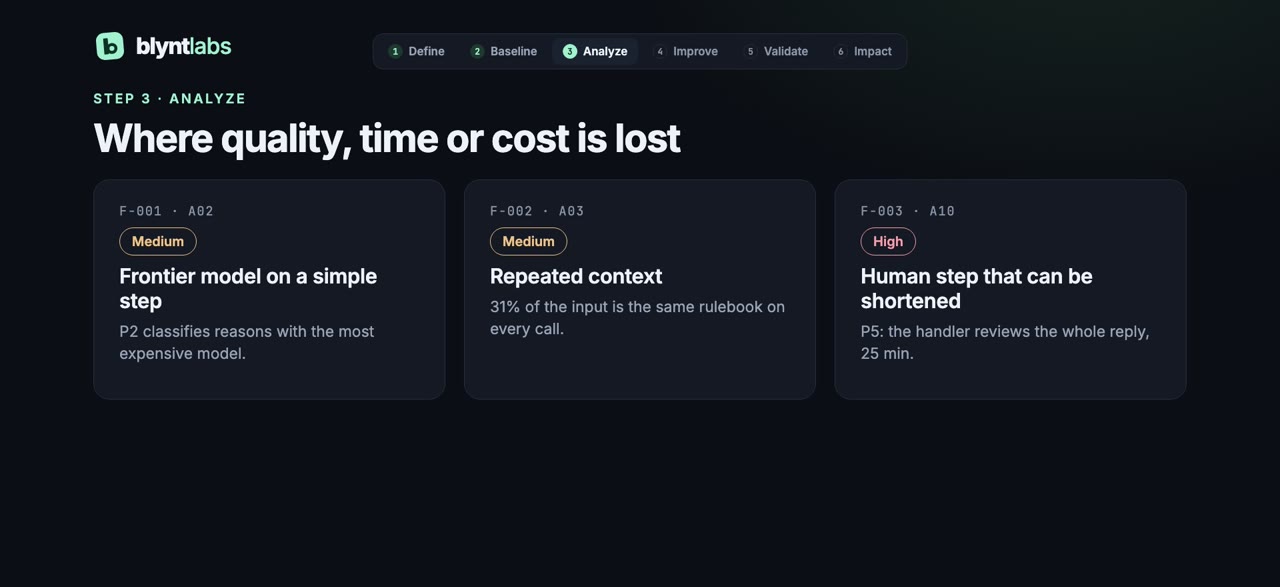
BLYNT Platform screen: Analyze
Deterministic rules, with no AI and zero tokens, point to where quality, time or money is lost, with evidence and priority.
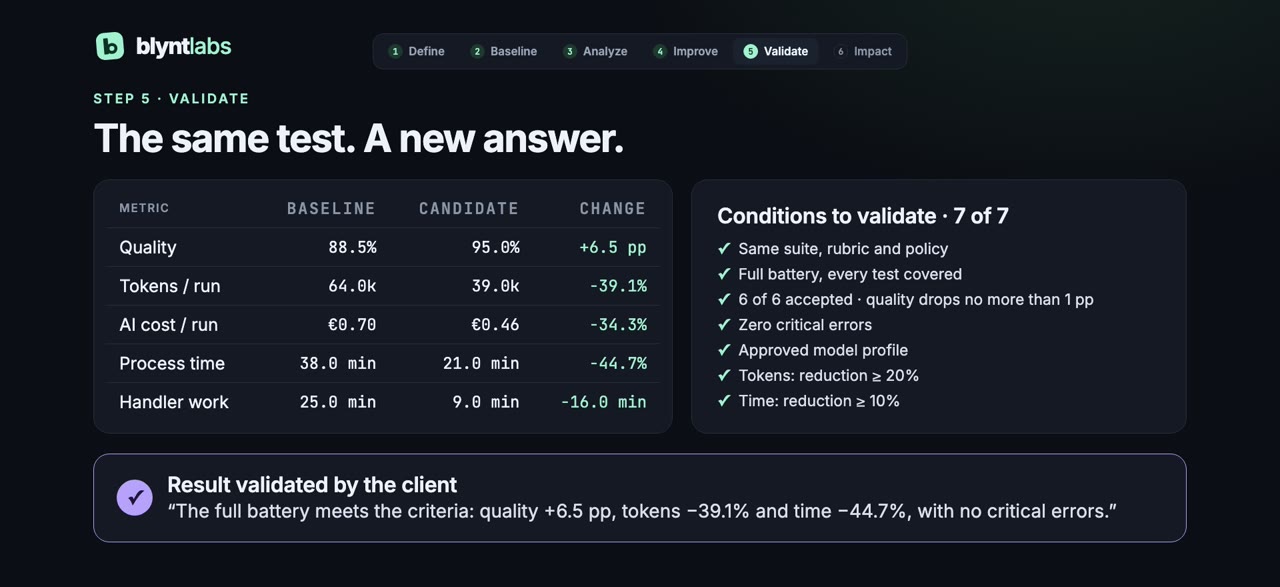
BLYNT Platform screen: Validate
The same test, a new answer: every metric side by side and every agreed condition checked before anyone signs.
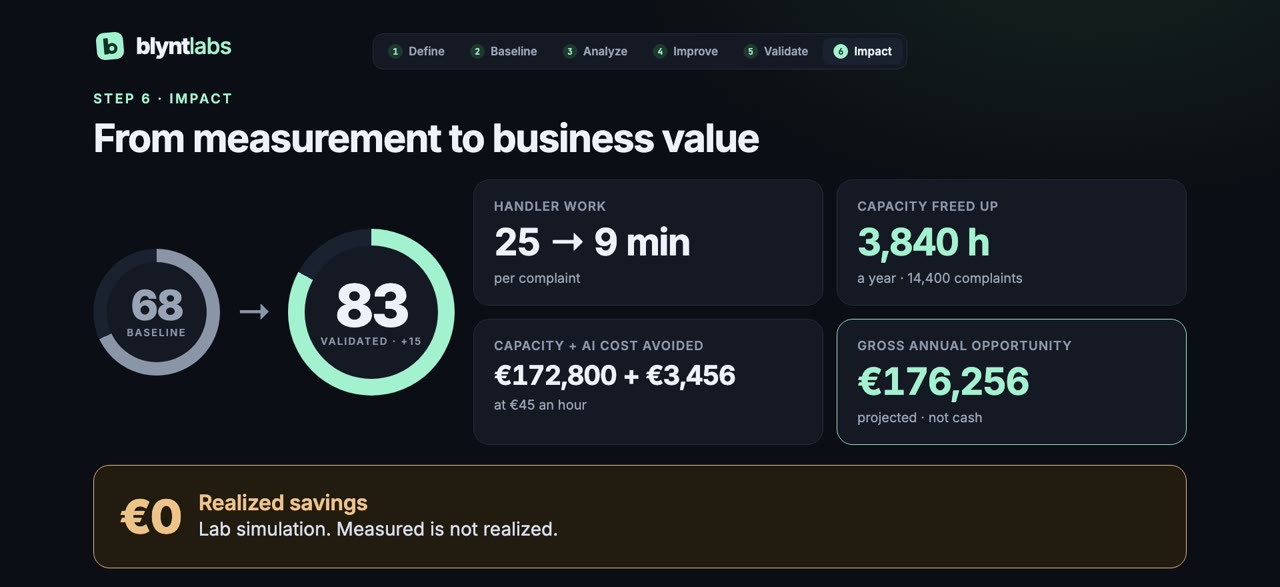
BLYNT Platform screen: Impact
Hours that can be freed and AI spend avoided, with the assumptions visible. Realized savings stay at zero until there's evidence.

For our team

  • Use cases, harness and versioned test suites
  • Controlled import of results and traces
  • Analyzer, improvements and validation

For your company

  • Sign off the baseline and the validation
  • Case, team and portfolio reports in PDF
  • Governance, people, maturity and audit history

Screens from a fictional example with synthetic data.

Where to start

Two ways in, depending on where your company stands

Already using AI

Measurement and improvement program

For companies with assistants, agents or chat licenses in place that need to prove their value and improve it.

  • A versioned test suite for every use case
  • BLYNT Score before and after every change
  • Diagnosis of quality, cost, time and tokens
  • Also works with chat licenses that don't report tokens
  • Case, team and portfolio reports in PDF
  • Governance, people and champions in one place
  • BLYNT Platform access for your team, included
What backs us

Behind every number there is a framework, not an opinion

The BLYNT framework is a documented method, built into our own software, BLYNT Platform. The rules are written before anyone looks at the results, and every number in the report can be opened down to the test that produced it.

Case performance

BLYNT Score

A 0–100 score that combines quality, cost, time and feedback, with weights agreed before testing.

How it's calculated →
Organizational capability

BLYNT Maturity

Five pillars that tell you whether the improvement can last: engineering, evaluation, governance, people and measurement.

See the five pillars →
Ground rules

Ten principles

Measured is not realized. History is never rewritten. Only compare what is comparable. And seven more.

Read the principles →
Your data, your decisions

Built for companies that can't afford mistakes

The method was designed for demanding, regulated environments. That's why it assumes audits, confidentiality and human sign-off from day one.

  • Your data stays in your company. BLYNT Platform doesn't call AI models or connect to your systems.
  • A person decides, not the tool. The baseline and the validation are signed off by an identified person from your company.
  • No inflated numbers. Measured, projected and realized figures are never added together.
  • Everything is on record. Every change has an author, a date and a history that can't be erased.
  • In English and Spanish. Platform and reports in both languages, in your currency.
Frequently asked questions

Before we talk

Do we need to be using AI already?

No. If you're not using AI yet, we measure the manual process as it runs today and have it signed off as the baseline. That's what the AI Readiness Assessment is for: when AI arrives, there will be something real to compare it with.

Can we buy BLYNT Platform on its own?

No. BLYNT Platform is the tool our team works with, and it comes included in every assessment and program. Your company gets its own access to review results, sign off decisions and download reports for as long as the engagement lasts.

Do you need access to our systems or data?

BLYNT Platform doesn't connect to your systems or call AI models. Tests run in the environment you authorize, and only numeric results, synthetic or authorized test content and governance evidence are loaded. Keys and plain-text prompts are never stored.

Do you replace the AI tool we use?

No. BLYNT measures, diagnoses and helps improve the tool you choose. We can help you select and configure it, but we don't sell it or replace it.

What if we use a chat license such as ChatGPT Enterprise, with no token data?

It works. Quality, time and feedback are still measured; cost leaves the Score and its weight is shared among the other dimensions, and it's always flagged.

How long does it take?

The assessment takes four weeks. For a broader scope, such as integrations or coordinated changes, we propose a 90-day pilot with one team and one or two use cases, ending in a clear decision: scale, adjust or stop.

Do you guarantee savings?

No, and we'd be wary of anyone who does. We measure. Everything we project is labeled as projected, and realized savings stay at zero until there is evidence from production.

Let's talk

Which process would you like to measure first?

Tell us in two lines what your team does and where you think AI could help. We'll reply with an assessment proposal.